
Answer Capsule: Yacht and hotel mattresses demand fire compliance (IMO FTP Code, 16 CFR 1633), irregular-shape cutting for curved cabins, and extreme breathability against marine humidity. Pure natural horsehair and silk, hand-tufted with zero chemical foam, solve all three at once. That is the core of our custom mattress specifications for superyachts, luxury villas, and boutique hotels.
I once walked into a 55-meter yacht where the owner's bed was a stock king, angled into a trapezoidal berth with a six-centimeter gap down one side. The designer shrugged. The crew blamed the shipyard. Nobody blamed the specification.
That is exactly why I am writing this.
I run a factory that builds pure-natural, hand-tufted mattresses — no chemical foam, ever. We have shipped to superyacht outfitters in Genoa, boutique hotels in London, and private villas from Dubai to Shanghai. One lesson keeps repeating: beautiful is not the same as compliant, and compliant is not the same as custom. A great project needs all three, written down.
This guide gives designers, architects, and project managers the real numbers — fire standards, tolerances, timelines, prices — before you call a supplier. Here is what we have learned.
Key Takeaways
- Answer Capsule: Yacht and hotel mattresses demand fire compliance (IMO FTP Code, 16 CFR 1633), irregular-shape cutting for curved cabins, and extreme breathability against marine humidity. Pure natural horsehair and silk, hand-tufted with zero chemical foam, solve all three ...
- BONJOUR LUXE supplies contract mattresses to boutique hotels, resorts and superyacht projects, with custom sizing, fire-safety certification for multiple markets, and dedicated project management from spec to delivery.
- This guide covers key considerations for buyers evaluating how do you specify custom mattresses for superyachts, luxury villas and boutique hotels?.
Why These Three Projects Need Completely Different Mattresses
Most people assume a mattress is a mattress. It is not. A chain hotel buys the same model for 40 rooms and sleeps fine. A yacht cannot. A villa cannot. Here is the breakdown.
The marine problem: humidity, fire rules, and curved steel
A yacht berth is hostile to a normal mattress. Cabin humidity at sea regularly sits at 70–80 percent. A synthetic foam core absorbs that moisture, then slowly turns into a warm, dark, mold-friendly sponge. I have seen six-month-old memory foam on a yacht come out smelling like a wet basement.
Then there is fire. Yacht accommodation is governed by the IMO FTP Code — specifically Part 3, the resistance-to-ignition test for bedding components. US-flagged vessels, and many US-bound projects, also trigger 16 CFR 1633, the federal open-flame standard. Your mattress either passes these with a test report, or it does not go on board. There is no "probably fine" on a marine survey.
And the shape. Berths follow hull curves, so almost every yacht mattress we make is an irregular shape mattress custom-cut to a template, with beveled edges and a ±5 mm tolerance. Last year a 60-meter yacht in Genoa needed a nine-piece bedroom set around a curved bulkhead. The template alone took three visits.
The hotel problem: 365 nights of abuse
Hotels are the opposite problem: regular shapes, brutal usage. A commercial mattress lives 10–15 years versus 7–10 at home, while guests jump on it, spill on it, and rarely rotate it. In the UK that means BS 7177 ignition-source ratings — Source 0 (cigarette) up to Source 5 (large flame) — and many premium operators now spec Source 5. In the US, 16 CFR 1633 applies again.
Budget tells you the grade. A luxury hotel's handmade horsehair mattress runs $2,000–5,000 per piece. A business hotel's hybrid runs $400–800. Boutique custom sits at $600–1,200. Different products, different builds, different suppliers — know which bracket you are designing for before you ask for quotes.
The villa problem: one client, zero compromise
Villas carry none of the hotel constraints and all of the ego. One client wants a split-firmness king, plush on her side, firm on his. Another wants camel down in the winter layer and a monogrammed, hand-tufted crest. We have built round beds, trapezoid daybeds, and mattresses for rooms where the ceiling is lower than the bed frame. Cost matters less than the story. That is the luxury villa mattress brief in one sentence.
What is technical specification checklist?
Write these numbers into your specification sheet before you request quotes. If a supplier hesitates on any line, walk away.
| Parameter | Superyacht | Boutique Hotel | Luxury Villa |
|---|---|---|---|
| Thickness tolerance | ±5 mm | ±5 mm | ±5 mm |
| Fire standard | IMO FTP Code Part 3; 16 CFR 1633 (US-flag) | BS 7177 Source 0–5; 16 CFR 1633 (US) | Hotel-grade, project-specific |
| Shape | Full custom cutouts, beveled edges | Standard sizes plus suite cutouts | Full custom, curves, split zones |
| Moisture & ventilation | High: marine humidity, vapor-permeable core required | Medium–high: daily use, laundering | High: coastal climates, wellness rooms |
| Service life target | 10–15 years | 10–15 years | 10–15 years |
Two details are worth arguing about. First, tolerance: ±5 mm is not a suggestion, it is the difference between a flush fit and a visible gap in a multi-million-euro interior. Second, certificates: ask for the actual IMO FTP Code Part 3 and 16 CFR 1633 test reports, not a line in a brochure. A marine luxury mattress specification without a report number is a bedtime story.
For irregular shapes, our cutout process looks like this: template the berth on site; digitize the template into CAD; hand-cut the base layers to ±5 mm; build and hand-tuft the mattress; trial-fit a mockup before the final unit ships. Every step exists because one of them was skipped somewhere, once, and somebody paid for it.
What is Material Logic: Why Natural Fibers Beat Synthetic Foam Here?
This is the part I care about most, and the part most spec sheets get wrong.
| Material | What it does | Where it wins |
|---|---|---|
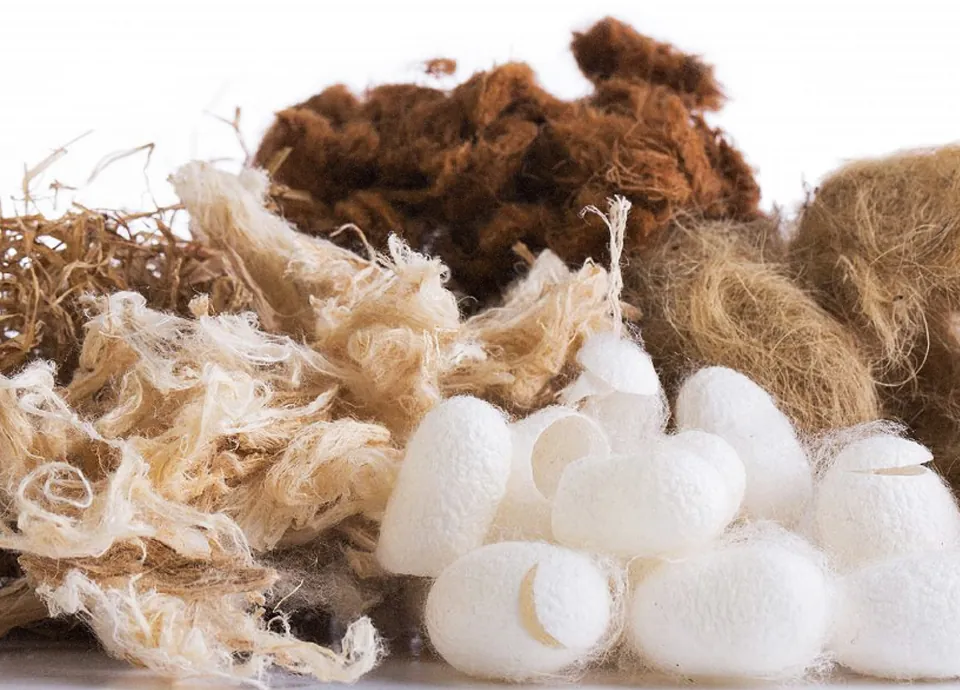
| Horsehair | Hollow fibers wick vapor and bounce back | Marine cores, breathable support |
| Silk | Thermoregulating, hypoallergenic, moisture-wicking | Top layers for guest comfort |
| Wool | Naturally flame-resistant, temperature-regulating | Mid layers, fire-safety support |
| Camel down | Lightweight warmth, buffers humidity | Villa and yacht winter layers |
| Alpaca | Ultra-soft, thermal balance | Boutique toppers |
| Organic cotton (GOTS) | Skin-safe, OEKO-TEX® Class I | Covers and ticking |
| Memory foam | Cheap, molds to the body — traps heat and moisture | Avoid in marine use |
Synthetics fail in exactly the environments this article is about. Foam traps moisture, breeds mildew, and sleeps hot. It also off-gasses VOCs, which quietly undermines the hygiene story a five-star hotel is selling. Natural fibers do the opposite: horsehair's hollow shafts move vapor out of the core, wool buffers temperature swings, and silk keeps skin dry. In marine humidity, that is not luxury — it is engineering.
There is a durability argument too. A foam core degrades in 5–8 years. Natural fibers last 20–30 years, which is why a $3,000 horsehair mattress amortizes better than a $600 foam one across a 15-year hotel cycle. And because everything is hand-tufted — 3–6 hours of needlework per queen — repairs are possible, which commercial buyers quietly love.
Certifications close the deal. Our covers and fillings carry OEKO-TEX® Standard 100 Class I, the infant-safe grade, plus GOTS for organic cotton. For a hotel's ESG report or a yacht's guest brochure, those two lines do real marketing work.
What is the difference between The Sourcing Process and Timeline?
Here is what a realistic schedule looks like — and why yacht bed sets are always the slow ones.
- Measure. Designers send drawings; for yachts we template on site. Hulls flex, builders drift, drawings lie.
- Sample. First prototype in 15–30 days. For yachts, plan a second round: berth geometry changes, or the surveyor adds a fire requirement.
- Trial fit. A mockup at the berth. Cheap insurance before 45 days of production.
- Produce. 45–75 days, depending on volume and tufting hours.
- QC and ship. Test reports, moisture-barrier packaging, marine-safe transit.
| Stage | Duration | Notes |
|---|---|---|
| Measurement & templating | 1–2 weeks | On-site for yacht berths |
| Sampling (round 1) | 15–30 days | Certified materials, prototype |
| Trial fit & revision | 1–2 weeks | Second sample for yachts — mandatory |
| Mass production | 45–75 days | Monthly capacity 500–3,000 units |
| QC, packaging, shipping | 1–2 weeks | Test reports plus moisture barrier |
Capacity matters at scale. Our lines run 500–3,000 mattresses a month, so a 40-room hotel refit and a single villa commission sit comfortably on the same floor. As an OEM/ODM source, we produce under your brand, with your spec, or with ours — that is the whole point of a boutique hotel handmade mattress supplier.
One honest note on minimums: for a full-custom yacht set, the MOQ can be a single berth. For hotels, we push you to standardize two or three models, because consistency is what guests actually feel at 2 a.m.
FAQ
Do superyacht mattresses have to meet IMO FTP Code or 16 CFR 1633? It depends on flag and class, but treat both as likely. International yachts generally follow IMO FTP Code Part 3 through the flag authority; US-flagged vessels and US-bound hotels typically require 16 CFR 1633. Ask for test reports — wool-based natural builds support these standards without chemical treatments.
Can you really make an irregular-shaped mattress for a curved berth or a round bed? Yes — it is our specialty. We template on site, digitize the shape, cut to ±5 mm, and bevel the edges. Trapezoid berths, L-shaped daybeds, round villa beds, nine-piece curved suites: all standard work for us.
What are realistic lead times and minimum orders? Samples take 15–30 days; production 45–75 days; monthly capacity is 500–3,000 pieces. Budget two sample rounds for yacht sets. Full-custom yacht MOQ can be one berth; hotels should standardize models for consistency.
Written from the workshop floor at Bonjour Luxe (佰仕禄), a Chinese manufacturer of pure-natural, hand-tufted luxury mattresses — zero chemical foam, OEKO-TEX® Standard 100 Class I, GOTS-certified organics, and an ISPA member. From single yacht berths to 3,000-piece hotel runs, we build custom mattress specifications for superyachts, luxury villas, and boutique hotels worldwide. Visit bonjourluxe.com or our brand showcase to start a conversation.