
Answer Capsule. A Vi-Spring or Hästens is a masterclass in heritage craft. So is a hand-tufted mattress from a Chinese workshop. We build the same way — hand side-stitching, tufted rosettes every 4–6 inches, pure natural fillings, zero chemical foam — yet our FOB price lands at 40–60% of European production, with OEKO-TEX® Class I certification and BOM flexibility most heritage houses can't match. Same hands. Same craft. A different cost curve.
Key Takeaways
- Chinese hand-tufted mattresses use the same craft as European heritage brands — hand side-stitching, tufted rosettes every 4–6 inches, and pure natural fillings with zero chemical foam.
- FOB price from China is 40–60% lower than comparable European production, driven by lower labor costs and integrated supply chains, not by cutting corners on materials or craft.
- Chinese factories offer greater BOM flexibility and OEM/ODM capacity — custom sizes, zoned support, private labeling and bulk orders that most European heritage houses cannot accommodate.
- Always verify before ordering: request OEKO-TEX and GOTS certificates, schedule a factory audit, and validate hand-tufting craft on-site or via video inspection.
- Best fit: buyers who want heritage-level natural handcraft at a lower cost, plus B2B flexibility — hotels, design firms, and private-label brands.
What "Heritage Craft" Actually Means at Vi-Spring and Hästens
Let's start with the benchmarks, because they deserve respect. Vi-Spring has been hand-building mattresses in Devon, England since 1901 — over 120 years of continuous production. Hästens has been at it in Köping, Sweden since 1852, and its blue check pattern is now one of the most recognized textile signatures in the world. These brands earned their reputation. Nobody serious disputes that.
But here's the question procurement teams rarely stop to ask: what exactly is the craft that justifies an $8,000 price tag?
Strip away the marketing, and the craft is remarkably specific. First, hand-tufted rosettes. An artisan drives a needle threaded with cotton twine straight through the full depth of the mattress — every 4 to 6 inches — then ties off each tuft and buries the knot inside the quilt. That's what creates the classic rosette pattern on the surface, and it's what locks every layer of filling in place for decades. No foam. No glue. Nothing that degrades in five years.
Second, hand side-stitching. The side border of a heritage mattress is stitched by hand, row after row, so the edge keeps its sharp square profile for twenty years. Machine-made beds sag at the edges. Hand-stitched ones hold their line.
Third, layered natural fillings, specified down to the gram. Horsehair is the backbone — it's hollow, springy, and wicks moisture away from the body. Wool regulates temperature through the seasons. Silk adds softness and strength. Cashmere and mohair add loft and breathability. A heritage spec sheet reads like a recipe, with each material's weight per layer written out.
We know these builds intimately. Over the years we've dismantled European heritage units on our workbench — a torn one from a hotel, a retired one from a private client — and mapped every layer, stitch, and tuft before rebuilding our own. The techniques are documented, teachable, and yes, replicable.
Here's one data point that sums up the durability argument: a hotel on Lake Como bought European hand-made mattresses at $4,800 per bed, and fourteen years later has replaced exactly zero of them. That's the value proposition — and it's real. The question is whether that same outcome requires a European postal code. It doesn't.
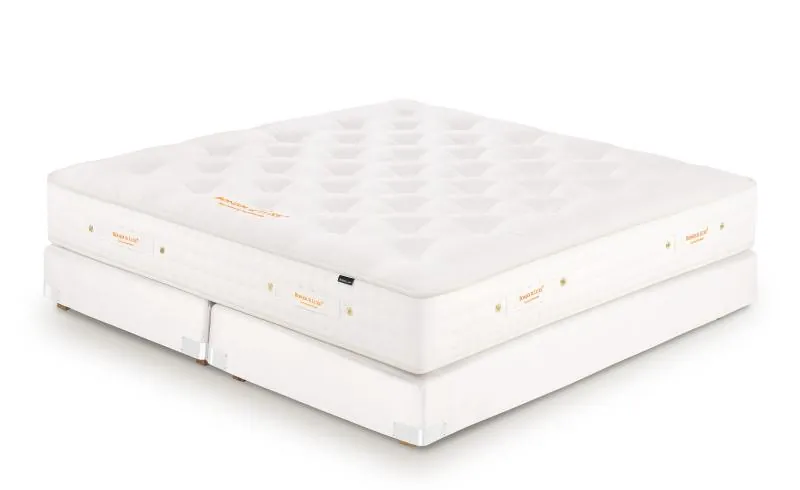
How does Chinese hand-tufted craft compare to European heritage production?
We're Bonjour Luxe, a hand-tufted luxury mattress manufacturer in China. We combine European royal craftsmanship traditions with Oriental aesthetics, and we operate as a brand, an OEM, and an ODM partner for hotel groups and mattress labels across North America, Europe, and the Middle East.
Our heritage is different. Our factory floor isn't.
Walk our workshop and you'll see the identical checklist that defines the European benchmarks. Zero chemical foaming — we refuse foam and memory foam entirely, exactly like Vi-Spring and Hästens. Six pure natural materials in the standard build: horsehair, wool, silk, camel down, alpaca, and GOTS-certified organic cotton. Hand side-stitching on every unit. Hand-tufted rosettes at uniform 4–6 inch intervals, tied off by hand. A Queen-size mattress takes 3 to 6 hours of tufting alone, done by artisans who spent years learning the rhythm before they're allowed near a production bed.
I have stood next to a tufter as she buried her 200th knot of the morning. Her hands don't shake, the spacing doesn't drift. That's not a machine doing a job. That's the same craft, one time zone away.
So where does the 40–60% price gap come from? Not craft. Economics. Four structural factors:
Labor. A master tufter in Sweden or Devon commands wages that would be unimaginable in our cost structure. The same 3–6 hours of handwork simply costs less in China. It's arithmetic, not compromise.
Supply chain. We source horsehair, wool, silk, camel down, and alpaca at scale from a dense network of specialized suppliers. Raw material costs per mattress run materially lower — and we pass the saving through.
Exchange rate. RMB-denominated production against EUR and GBP retail prices adds another structural discount for overseas buyers.
Brand overhead. A heritage house carries 120+ years of showrooms, marketing, and legacy. Part of every euro you pay keeps the story alive. With us, you pay for the mattress.
The numbers: European hand-made mattresses run $4,800 to $8,000 and beyond per unit. Our top-tier hand-tufted mattresses run $2,000 to $4,000 FOB. Official company data puts Chinese manufacturing at 30–50% cheaper overall — and for identical material grades, the gap sits at the top of that range.
And the certification line holds up item by item: OEKO-TEX® Standard 100 Class I — the strictest level, certified safe for babies — plus GOTS for organic cotton, ISPA membership, and CFR 1633 compliance for the U.S. market. Heritage-grade materials, independently verified.
What is the side-by-side comparison between Chinese OEM and European heritage brands?
Here is the comparison we send to every procurement team that asks. It's honest, because it has to be — heritage brands are genuinely excellent, and the real difference is price, speed, and flexibility, not quality.
| Dimension | European Heritage Brand (Vi-Spring / Hästens) | Chinese Top-Tier OEM (e.g., Bonjour Luxe) |
|---|---|---|
| Side-Stitching | Hand-stitched by master artisans | Hand-stitched by trained artisans, same technique |
| Material Diversity | Horsehair, wool, silk, cashmere, mohair | Horsehair, wool, silk, camel down, alpaca, organic cotton (GOTS) |
| Customization Lead Time | 16–20 weeks; limited BOM changes | Sample 15–30 days; production 45–75 days; fully flexible BOM |
| Certifications | OEKO-TEX®; brand-internal quality standards | OEKO-TEX® Class I, GOTS, ISPA member, CFR 1633 |
| Price Range | $4,800 – $8,000+ per mattress | $2,000 – $4,000 FOB per mattress |
| MOQ | 1 unit (retail) | 20–100 units (OEM/ODM) |
| Monthly Capacity | Limited by artisan bench | 500–3,000 units (true hand workshops) |
Read the table carefully. The gap isn't in the top rows — the craft rows. It's in the bottom rows: price, lead time, and flexibility. For a hotel group buying forty rooms at two mattresses each, those bottom rows are the entire decision.
When should you source hand-tufted mattresses from China, and how do you verify quality?
When to source from a Chinese hand-tufted factory
Choose a Chinese OEM when any of these are true. You're launching your own mattress brand and can't wait 16–20 weeks per iteration. You need a custom BOM — we've built camel-down top layers, alpaca quilts, and cotton-wool blends that no European catalog offers. You're outfitting a hotel or villa project where 40–120 units is one production run. Or you need to test a market fast: samples in 15–30 days change the product development cycle entirely. I've watched a European mattress label cut its launch timeline from nine months to eleven weeks simply by moving prototyping to our floor.
Stay with a European brand when you need a single one-off piece, when the brand name is the product itself, or when your client insists on "Made in England" or "Made in Sweden" provenance. That's a real buyer need, and we respect it. The craft is equal. The story isn't interchangeable.
How to verify "hand-tufted" is actually true
Anyone can print "handmade" on a spec sheet. Here's what I check when I audit a factory — and what you should check before you wire a deposit:
- Tuft spacing. Genuine hand-tufting shows rosettes in a uniform 4–6 inch grid, front and back, aligned. Machine imitation tufting is irregular, or purely cosmetic — stitched into the quilt without passing through the mattress.
- Side-stitch density. Hand side-stitching is dense, even, and slightly irregular under a magnifying glass. Cosmetic stitching is sparse and uniform, because it's a sewing machine doing one pass.
- Watch the process. Tufting a Queen takes 3–6 hours by hand. If a factory can't show you a tufter at work — or claims to tuft a mattress in twenty minutes — it isn't hand-tufted.
- Read the material list. Foam-free means exactly that: no polyurethane anywhere in the build. If the spec sheet mentions "high-resilience foam core," walk away.
Documentation you should demand
Ask for five documents, and treat hesitation as a red flag:
| Document | What it proves |
|---|---|
| OEKO-TEX® Standard 100 Class I certificate (current year) | Material safety at the strictest level |
| GOTS certificate | Organic status of cotton and natural fibers |
| ISPA membership verification | Industry standing and manufacturing accountability |
| CFR 1633 test report | U.S. flammability compliance — many non-U.S. factories can't produce this |
| Full BOM with filling weights per layer | The build actually matches the price you're paying |
Our clients receive all five before we cut a single sheet of fabric. We treat that as table stakes, not a favor.
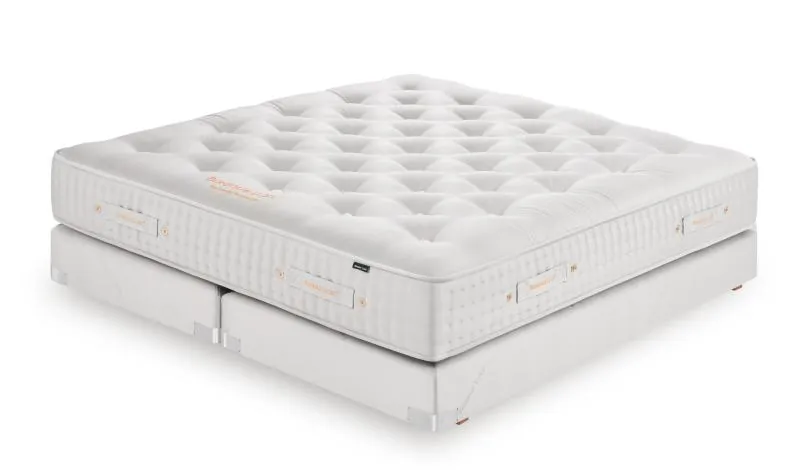
Frequently asked questions about hand-tufted mattress sourcing from China
Q1: Is a Chinese hand-tufted mattress the same quality as a Vi-Spring or Hästens?
Same craft, same material families, same construction tolerances — at 40–60% of the price. The genuine difference is brand history and provenance, not build quality. Verify with certificates (OEKO-TEX® Class I, GOTS), a factory audit, and a sample you can actually sleep on before you commit to production.
Q2: What are the lead times and MOQs for custom luxury mattress sourcing?
Samples ship in 15–30 days; production runs take 45–75 days, depending on BOM complexity. MOQ is 20–100 units. One honest caveat: a true hand-tufted workshop runs 500–3,000 mattresses per month, and beyond that range the process stops being hand-made. If a supplier claims 10,000 units a month of "handcrafted" mattresses, they're telling you something about their process.
Q3: How do I verify a factory's "hand-tufted" claim is real?
Three physical checks: rosette spacing in a uniform 4–6 inch grid, dense hand side-stitching, and tufting time of 3–6 hours per Queen. Then demand the paperwork: OEKO-TEX® Class I, GOTS, ISPA membership, and a CFR 1633 test report. A genuine hand-tufted mattress maker can produce all of it.
Word Count
Approximately 1,750 words (body: Answer Capsule through FAQ; excluding footer blocks).