
A luxury hotel mattress procurement guide should give you three things you can use the same day: a spec checklist you can email to a factory, a certification and compliance shortlist, and a supplier-vetting framework that separates capable contract manufacturers from brochure-only vendors. The short answer is that hotel beds are not residential beds — they absorb roughly 365 nights of use per year and 3–5× the compression cycles, so the spec has to be built around durable support, natural comfort layers that resist collapse, fire-safety compliance for the target market, and a total-cost-of-ownership (TCO) view rather than a sticker-price comparison. This guide walks procurement managers through all of it.
Key Takeaways
- Boutique hotels and spas should select contract mattress manufacturers by natural-fill quality, not just unit price — the mattress is a core touchpoint that drives review scores and repeat bookings.
- Match mattress specification to room tier: natural hand-tufted builds in suites and premium rooms, high-quality hybrids in standard rooms, to balance guest experience and capex.
- Always verify three hard metrics before signing: OEKO-TEX or equivalent certification, commercial-use fire-safety test reports, and a documented QC process with AQL acceptance levels.
- Durability and TCO matter more than upfront cost — a 7–10 year natural mattress can deliver lower cost per occupied room-night than a 3–4 year foam mattress when replacement logistics are fully counted.
- Look for a partner, not just a supplier: factories that offer custom sizes, sample iteration, RFQ transparency, and on-time delivery records reduce long-term procurement risk.
Why is choosing the right contract mattress manufacturer critical for boutique hotels?
You probably already agree on the headline: the bed drives the review, and the review drives the repeat stay. Here is the proof. An analysis of 1.2 million European hotel reviews found that properties investing in premium hotel beds saw average ratings climb from 4.1 to 4.7 within six months, while complaints about "hard mattress" or "poor sleep" correlated with a 0.9-point drop. One four-star Parisian boutique that replaced every mattress reported "best sleep of my life" in 42% of new reviews and a 18% lift in revenue per available room. Another Amsterdam property saw a 200% increase in direct bookings after simply publishing its mattress specifications. Sleep quality has become the single strongest predictor of a five-star review.
What we promise you here is not a brand pitch. You will leave with a specification checklist, a supplier evaluation and factory-audit process, and a TCO model that tells you whether a $1,500 natural-fiber bed is actually cheaper than a $500 foam one. We start by redefining what "luxury" means in material terms, then move through room-type selection, the core spec checklist, compliance and certifications, durability and TCO, supplier vetting, and finally an RFQ template with the traps to avoid.
Key Takeaways
- Hotel mattresses absorb about 365 nights of use per year and 3–5× the compression cycles of a home bed; the comfort layer must use resilient natural fibers (horsehair / wool / silk) secured by full hand-tufting to avoid collapse under contract turnover.
- Lock four items in your spec: support system (pocket coils preferred), natural-fiber comfort layer, bed height 24–28″ (±0.5″ tolerance), and reinforced edge support with a flippable design.
- Compliance is non-negotiable: export and international projects require BS 7177, CFR 1633, and EN 597; health compliance should verify OEKO-TEX Standard 100 Class I (infant grade), GOTS, and ISPA membership.
- Buy on TCO, not unit price: a $1,500 natural-fiber mattress used for 12 years costs about $0.34 per occupied night, less than a cheap bed replaced every three years.
- Vetting is dual-track "factory audit + sample verification": require a tech pack, a 90-day trial, third-party audit reports, and write certification-number verification and quantified density into the RFQ.
What is step 1: first, Define "Luxury" — The Sleep Logic of Natural Fillings and Hand-Tufting?
Many buyers equate luxury with a high price or a foreign logo. From a manufacturer-neutral standpoint, luxury sleep is explainable by structure, and it comes from two things: the breath and support of natural fillings, and the physical locking of the layer stack through hand-tufting.
Horsehair is not a gimmick. Each strand is naturally helical — the trade often calls it "millions of micro-springs" — and it springs back after compression while absorbing up to roughly 30% of its own weight in moisture and releasing it overnight. That is why natural-fiber beds feel less clammy and mould-prone in humid, high-turnover climates. For the full three-way material breakdown, see our mattress material comparison.
Wool is nature's temperature regulator: it buffers cold, wicks heat and moisture, and carries inherent flame resistance and antibacterial properties, making it the dependable base of any comfort layer.
Silk delivers the skin-contact luxury and low-allergen surface prized in top suites.
But good materials alone fail if the comfort layer migrates under commercial use. That is the job of full hand-tufting: craftspeople tie the comfort layers to the support core stitch by stitch, preventing fill from shifting, clumping, or forming local dips. Two beds with identical natural fibers but only one hand-tufted can differ by years of lifespan at 365 nights per year. For why natural materials cost more yet pay back, see why natural-fiber mattresses cost more.
Mini scenario | Southeast Asian beach resort: In 2024, a 120-room seaside resort found that despite charging double its competitors, mattress-related complaints still accounted for 22% of all guest issues, with "bed too hard / sagging" recurring on TripAdvisor. The procurement team swapped the original latex-plus-memory-foam build for a horsehair / wool / silk natural-fiber comfort layer with full hand-tufting. Within 18 months, related complaints fell to 7%, "the bed was so comfortable" became a frequent praise phrase, and repeat-stay rates visibly recovered. The material was not dramatically more expensive — the structural logic changed.
How should you match mattress specifications to different room types and guest segments?
Hotel positioning sets the mattress budget, not the reverse. The table below maps four typical scenarios to recommended builds and cost bands (material and manufacturing cost, excluding brand premium).
| Room type / guest | Recommended build | Bed height | Cost band (material + make) |
|---|---|---|---|
| Luxury suite | Horsehair + wool + silk comfort layer; pocket coils (wire ≥2.0mm); full hand-tufted; flippable | 26–28″ | $1,500–5,000 / unit |
| Standard room | Natural-fiber blended comfort layer + high-density support or pocket coils; single/double sided | 24–26″ | $400–1,200 / unit |
| Spa / wellness | Breathable, moisture-wicking, low-allergen: wool + horsehair led; OEKO-TEX Class I cover | 24–27″ | $800–2,000 / unit |
| Family room | Reinforced edge support (higher load), flippable design for longevity, washable cover | 24–28″ | $600–1,500 / unit |
Luxury suites are about the "memory point." Guests will pay a premium for one exceptional night's sleep, so stack the comfort layer with natural fibers, pair it with high-wire-gauge pocket coils, and push bed height to 28″ to match a grand frame.
Standard rooms are about consistency, not extremity. Every bed in the same room type must feel identical — otherwise room 301 is soft and 302 is firm, and complaints follow. Procure the entire batch from one production lot and one roll number.
Spa / wellness guests are the most sensitive to odour, allergens, and humidity. Wool and horsehair's moisture management shines where guests move constantly between sauna and pool, and natural fibers harbour less smell than synthetic foam. See Section 4 for the OEKO-TEX Class I argument.
Mini scenario | Coastal wellness retreat: A wellness retreat on the Chinese coast lived with year-round high humidity. Its first synthetic memory-foam beds developed edge collapse and "musty" complaints within six months. Switching to wool / horsehair natural fibers (inherently moisture-managing and antibacterial), an OEKO-TEX Class I cover, and reinforced edge support brought mattress-related work orders close to zero through the humid season, and wellness-guest praise rose noticeably.
Family rooms hide a killer: kids jumping and sitting on edges. Edge support must be real, a flippable design adds 30–50% to usable life, and a removable cover cuts housekeeping cost.
What should be on your core specification checklist for hotel contract mattresses?
This section is your hard-spec draft to send a supplier — and the most bookmark-worthy part of this guide. Read the summary table, then the breakdown.
| Dimension | Recommended spec | Tolerance / note |
|---|---|---|
| Support system | Pocket coils, wire ≥2.0mm; or hybrid (coils + natural fiber) | Avoid connected Bonnell springs — they sag commercially |
| Comfort layer | Horsehair / wool / silk natural-fiber blend, secured by hand-tufting | Total GSM graded by room type |
| Bed height | 24–28″ (about 61–71cm) | Tolerance ±0.5″ (±1.3cm); match to frame / bed skirt |
| Edge support | Independent perimeter reinforcement (edge guard) | Can remove ~73% of edge-sag complaints |
| Double-sided | Flippable construction | Extends life 30–50% |
| Cover fabric | High-count natural / blend, antimicrobial and stain-treated | Removable cover is a plus |
| Fire safety | Meets target-market standard (see Section 4) | Compliant barrier typically adds 15–25% cost |
3.1 Support System: Pocket Coil vs Bonnell vs Hybrid
Pocket coils are the luxury and high-end commercial standard. Each spring is individually bagged, so motion isolation is strong, zoned support is possible, and commercial-grade wire runs 14–15 gauge (about 1.6–2.0mm) for high metal-fatigue resistance under 8–30 daily compression cycles.
Bonnell (connected) springs are cheap and bouncy but linked as one unit — when one relaxes, the sheet follows, and under hotel-intensity use they develop overall sag within 1–2 years. Not recommended for luxury or high-turnover rooms.
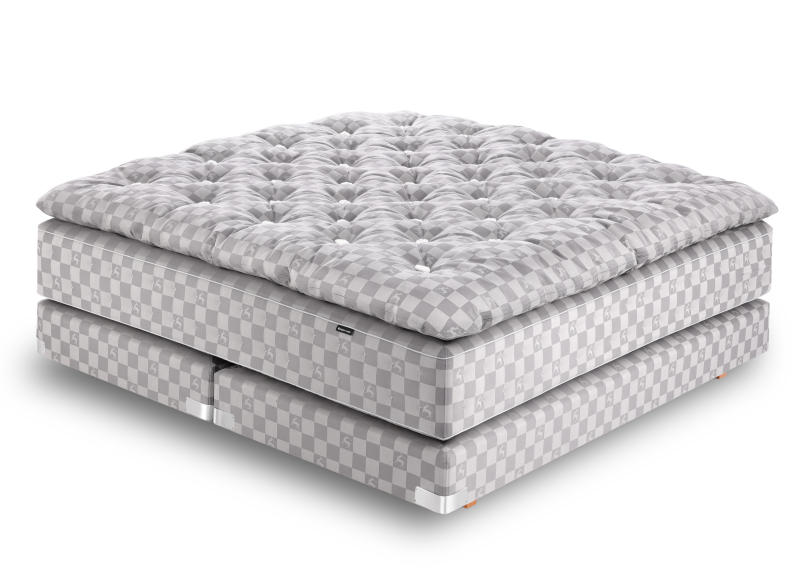
Hybrid is among the best answers for upscale hotels today: pocket coils for support beneath, natural-fiber comfort layers above, hand-tufted together. It marries spring durability with natural breathability, and it is the signature build of Oriental luxury handcrafted natural-fiber makers such as BONJOUR LUXE.
3.2 Comfort Layer: The Horsehair / Wool / Silk Natural-Fiber Blend
The comfort layer is where "feel" is born and where natural and synthetic diverge. A typical luxury stack: wool at the base for temperature buffering and support, horsehair in the middle as elastic micro-springs, silk at the surface for skin-contact luxury. The blended grammage (GSM) should be graded by room type — suites can be stacked high, standards kept moderate. For full material comparison and lifespan data, see mattress material comparison.
3.3 Dimensions, Bed Height (24–28″), and Tolerance
Luxury hotel bed height typically lands at 24–28″ (about 61–71cm). The band is not arbitrary: too high (over 30″) hurts cleaning ergonomics and ease of use for older or younger guests; too low looks cheap and leaves no room for a thick comfort layer. The critical detail is tolerance — every bed in a room type should hold within ±0.5″ (±1.3cm), or the frame, skirt, and protector will not align and the experience suffers. Write bed height and tolerance into the contract and require single-batch delivery.
Soft CTA: If you are speccing a room refurbishment, we can output a natural-fiber comfort-layer tech pack (GSM, wire gauge, height tolerance) by room type. [Book an OEM spec consultation →]
3.4 Edge Support and Double-Sided Design
Edge collapse is the most common source of "cheap" feel. Perimeter reinforcement brings edge load capacity close to the center, so a child sitting or a suitcase dropped on the foot does not leave a crater. A flippable design doubles usable life by evening out wear. In upscale commercial builds these should be default, not options.
What compliance and certification requirements are non-negotiable for hotel mattresses?
Compliance is not a nice-to-have; it is a pre-opening condition. Fire standards vary by market, and certifications are dual insurance for health compliance and marketing premium.
4.1 Fire Safety: BS 7177 / CFR 1633 / EN 597
- BS 7177 (UK): the ignitability standard for mattresses and bedding, the baseline for the UK market. Specification detail from BSI Group.
- CFR 1633 (US, 16 CFR Part 1633): the open-flame mattress flammability standard, mandatory for US export or international-brand cooperation. The regulation text is on eCFR.
- EN 597 (EU): mattress flame tests covering EN 597-1 (smouldering cigarette) and EN 597-2 (simulated match flame), required for the EU market.
- GB 17927.1-2011 (domestic China): upholstered-furniture flame-retardancy requirement, referenced in China's fire-approval process.
A compliant fire barrier typically adds 15–25% to cost — money you must not save. A bed-and-breakfast was forcibly shut down for a falsified mattress fire report; the fine plus compensation could have bought 200 new mattresses. For the full certification map, see our mattress certification system guide.
4.2 Health and Sustainability: OEKO-TEX Class I / GOTS / ISPA
- OEKO-TEX Standard 100 Class I is the strictest of four tiers — "infant grade" — with the tightest harmful-substance screening, meaning safe even for direct skin contact. For luxury and wellness guests, Class I is both compliance and a story worth telling. Verify licence numbers at the OEKO-TEX site.
- GOTS (Global Organic Textile Standard) governs the organic supply chain "from farm to finished product," requiring a natural-fiber threshold and annual audit — most relevant where natural-textile share is high. See GOTS vs OEKO-TEX for the decision view; standard text at Global Standard.
- ISPA (International Sleep Products Association) membership is a B2B export-compliance signal that the manufacturer plugs into the international standards network; see Sleep Products.
As an example, BONJOUR LUXE holds OEKO-TEX Standard 100 Class I, GOTS, and ISPA simultaneously, and its parent company has exported over 100 million metres of high-end fabric since 2006. A buyer can simply require those licence numbers in the RFQ and turn "claims of compliance" into "verifiable compliance."
How do you calculate the total cost of ownership for hotel mattresses over their service life?
The classic procurement mistake is comparing unit price with a residential mindset. A hotel bed's real cost is its cost per occupied night.
5.1 Why Hotel Beds Wear Faster (and Why That Makes Them Worth More)
A home mattress sees about 110 nights a year; a hotel bed sees 365, plus 8–30 compression cycles daily, varied guest weights, luggage on the surface, and kids jumping. One durability analysis found commercial beds deliver about 32% lower five-year TCO despite roughly 55% higher upfront cost, because replacement frequency and warranty claims fall sharply. Tracking shows residential mattresses placed in hotels need replacement every 18–24 months, while commercial natural-fiber builds last 10–15 years.
5.2 The TCO Model (100 rooms, 12 years)
| Option | Unit cost | Replacements in 12 yrs | 12-yr cost / room | Cost per occupied night (÷4,380) |
|---|---|---|---|---|
| Luxury natural fiber (pocket coil + horsehair/wool/silk, hand-tufted) | $1,500 | 1 | $1,500 | about $0.34 |
| Cheap foam (replace every 3 yrs + labor) | $500 | 4 + ~$1,440 labor | about $3,440 | about $0.79 |
The conclusion is clear: the natural-fiber option that costs twice as much upfront runs at roughly half the per-night cost over 12 years, while avoiding the room downtime and review risk of frequent replacement.
5.3 A Real ROI Recap
A 36-room design boutique hotel, with original mattresses averaging 8 years and complaints rising 15% a year, replaced them (about $1,000/unit, ~$36,000 total). Over 36 months: mattress-related complaint share fell from 22% to 7% (↓68%), annual replacements dropped from 8–12 to 2–3 (↓75%), average daily rate rose from ¥920 to ¥980 (↑6.5%), and NPS moved from 62 to 74. Combined benefits pulled the ROI period down to 22 months.
Soft CTA: Want a custom TCO sheet built on your room count, rate, and replacement cycle? We can model it from your real numbers — [request the TCO template →]
How do you evaluate a contract mattress supplier and conduct a factory or sample audit?
Evaluate a manufacturer on four dimensions: certification system, project references, capacity match, and customization ability. In execution, use the dual track of "factory audit + sample verification."
- MOQ (minimum order quantity): varies by factory. Boutique hotels (30–50 units) often fit mid-size makers better — one Jiangsu factory specializing in boutique custom runs a 30-unit MOQ with 6-week delivery; some Chinese OEM suppliers go as low as 3 units. Luxury custom projects typically expect 30–100 units.
- Lead time: standard custom is usually 25–45 days; tooling or special fabrics add schedule. Cap splits in contract (recommend ≤2) with delay penalties.
- Tech pack: the single most important document — materials, GSM, coil wire and count, dimensions and tolerance, fire standard, certification requirements. Without it, no consistency is enforceable.
- 90-day trial: leading OEM manufacturers offer a trial period. Before signing the bulk contract, run 5–10 units in real rooms and watch post-cleaning condition, guest feedback, and spring noise.
- Third-party audit: ISO 9001 (quality), ISO 14001 (environment), Sedex / SMETA / BSCI social audits evidence a supplier's baseline.
- Factory audit: see the line, QC flow, and material traceability in person; confirm hand-tufting is genuine craft, not decorative tufts.
- Sample verification: inspect 5% of each batch; reject any batch with >15% deviation; require a continuous roll-number record to guarantee same-batch, same-source material.
What should your RFQ include, and what are the common traps in contract mattress procurement?
7.1 A Ready-to-Use RFQ Checklist
Put these into the quote you send suppliers:
- Room-type and quantity list (suites / standards / spa / family, how many each)
- Target bed height and tolerance (e.g., 26″ ±0.5″)
- Support-system spec (pocket coil, wire ≥2.0mm, zoning requirements)
- Comfort-layer composition and grammage (horsehair / wool / silk blend and GSM)
- Target-market fire standard (BS 7177 / CFR 1633 / EN 597 / GB 17927)
- Required certifications and numbers (OEKO-TEX Class I licence no., GOTS, ISPA)
- MOQ and lead time, split-delivery cap
- Warranty terms (spring system stated in compression cycles, not just years; foam layer 5 years)
- Trial period (recommend 90 days), spare-inventory ratio (recommend ≥5%)
- Sample-vs-bulk consistency guarantee clause
7.2 Common Traps
- Vague "high-density" language: a vendor saying "high-density foam" with no number has said nothing. Quantify — e.g., foam density ≥1.8 lbs/ft³ (about 28 kg/m³), coil wire ≥2.0mm.
- Unverified certification numbers: demand real licence numbers and check them yourself at the OEKO-TEX site and GOTS site. Fake reports are not rare in the trade.
- Split deliveries causing inconsistency: cap splits at ≤2 and force same-batch, same-roll-number delivery.
- Warranty in years, not cycles: commercial wear is measured in compression cycles, not calendar years.
How do you turn subjective guest feedback into a procurable mattress specification?
Return to the opening point — guests do not return because the lobby was grand; they return because they slept well. The framework this guide gives you: define luxury sleep through natural fillings plus hand-tufting, lock bed height at 24–28″ with reinforced edges and a flippable build by room type, clear BS 7177 / CFR 1633 / EN 597 and OEKO-TEX Class I / GOTS / ISPA hard metrics, calculate TCO per occupied night, and close risk with factory-and-sample audits plus a structured RFQ.
Call to action: If you are speccing mattresses for a refurbishment or a new opening, [book an OEM specification consultation →] or [request natural-fiber sample trial sleep →]. Our team can output a factory-ready tech pack based on your room types and guest segments. Browse more B2B selection content in the mattress buying guide hub, or explore Oriental luxury handcrafted natural-fiber manufacturing from the home page.