
Key Takeaways
- Data Point: Compressed/Rolled Shipping — Cost Breakdown by Volume.
- NOT recommended for hand-tufted natural-fiber mattresses.
- Data Point: 40'HQ vs 40GP — Capacity and Cost Comparison.
- Mattress compressed to ~20% of original thickness via hydraulic press.
- Roll-wrapped in polyethylene with desiccant
What is the difference between Mode 1 — Compressed and Rolled (Vacuum?
Vacuum compression is the standard for bonded foam and spring mattresses shipped in polybags. The mattress is machine-compressed, rolled, sealed in plastic, and packed into master cartons.
How it works:
- Mattress compressed to ~20% of original thickness via hydraulic press
- Roll-wrapped in polyethylene with desiccant
- Loaded into corrugated master cartons
- Cartons loaded into 20GP or 40GP container
Data Point: Compressed/Rolled Shipping — Cost Breakdown by Volume
Parameter 50 Units 150 Units 300 Units Notes Sea freight (40GP, FCL) $1,500–2,500 total $1,500–2,500 total $1,500–2,500 total Fixed container cost Per-unit freight $30–50/unit $10–17/unit $8–12/unit Economies of scale Landed cost range $200–500/unit $150–350/unit $100–300/unit Includes freight Source: bonjourluxe Content Team, based on China's mattress belt analysis, 2025–2026
Typical costs:
| Parameter | Value |
|---|---|
| Sea freight (40GP, FCL) | $1,500–2,500 total |
| Per-unit freight cost (50 units) | $30–50/unit |
| Per-unit freight cost (300 units) | $8–12/unit |
| Landed cost (40GP, 300 units) | $200–500/unit |
⚠️ NOT recommended for hand-tufted natural-fiber mattresses. The tufting process creates internal anchor points that do not compress uniformly. Repeated compression causes tufting threads to fatigue, ticking to pucker, and filling layers to shift — permanently.
[Source: ISO 9001:2015 Quality Management Systems — ISO.org]
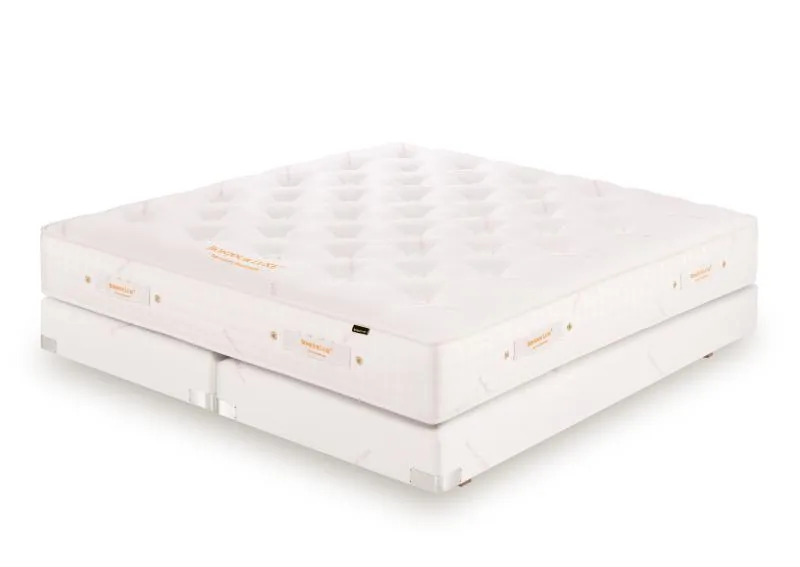
What is Mode: �� Flat-Packed (40'HQ Container)?
The only shipping mode that respects the structural integrity of hand-tufted constructions — and for mattress shipping from China flat pack is the standard for natural-fiber constructions.
How it works:
- Mattresses laid flat, never compressed
- Individually wrapped in breathable fabric + moisture-barrier polybag
- Stacked on custom pallets (max 3 high, alternating orientation)
- Loaded into 40'HQ container (internal: 12.03m × 2.35m × 2.69m)
- Corner posts and strapping prevent in-transit shifting
Why 40'HQ over 40GP:
| Parameter | 40GP | 40'HQ |
|---|---|---|
| Internal length | 12.03m | 12.03m |
| Internal height | 2.28m | 2.69m |
| Usable volume | ~67.7 m³ | ~76.3 m³ |
| Pallet stacks | 2 high | 3 high |
| Units per container (twin) | 180–200 | 280–320 |
Data Point: 40'HQ vs 40GP — Capacity and Cost Comparison
Parameter 40GP 40'HQ Advantage Internal height 2.28m 2.69m 40'HQ: +18% stacking height Pallet stacking 2 high 3 high 40'HQ: +50% units per container Units per 40'HQ (twin) 180–200 280–320 40'HQ: +40–50% capacity Freight cost per unit Higher Lower 40'HQ: ~$1–1.50/unit Source: bonjourluxe Content Team, based on China's mattress belt analysis, 2025–2026
Cost comparison table:
| Shipping Mode | Volume Range | Cost Per Unit | Suitable For | Recovery Time |
|---|---|---|---|---|
| Compressed / rolled (40GP) | 50–500 units | $8–50/unit | Bonded foam,innerspring | 24–72 hrs |
| Flat-packed (40'HQ) | 200–600 units | $200–500 total freight | Hand-tufted, natural-fiber | None — ready to sell |
| Flat-packed (LCL) | 20–199 units | $500–1,500 total freight | Hand-tufted, small orders | None |
A 40'HQ flat-packed order of 300 twin mattresses ships for $300–450 total freight. That's $1–1.50/unit in freight — the cost of a cup of coffee. The security of flat-pack is nearly free.
[Source: ISO 9001:2015 Quality Management Systems — ISO.org]
What is Freight Options: LCL vs FCL?
LCL — Less than Container Load
Used when your order is below the minimum for a full container — though for FCL vs LCL mattress freight decisions, FCL is almost always preferred for hand-tufted goods.
- Booking: LCL sea freight forwarder (COSCO, Maersk, or local forwarder)
- Consolidation: Your cargo consolidated into a shared container at the port of loading
- Minimum volume: As low as 1–2 cubic meters (CBM)
- Breakbulk at destination: Cargo de-consolidated at CFS (Container Freight Station)
- Drawback: Higher per-CBM cost, longer transit, more handling (higher damage risk)
- Typical lead time: Port-to-port 25–35 days + 5–7 days CFS handling
FCL — Full Container Load
Your container, your cargo, no handling by strangers — the preferred mode for mattress shipping from China flat pack at scale.
- Booking: Direct with shipping line or freight forwarder
- Minimum volume: Typically 20–28 CBM (fills a 20GP); 55–70 CBM (fills a 40'HQ)
- For 100×200×25cm twin mattresses: ~1.1 CBM per unit flat; ~65–75 units per 20GP; ~120–140 units per 40'HQ
- Lead time: Port-to-port 20–30 days (China major ports to US/West Europe)
- Recommended for: Orders of 100+ units; anything hand-tufted
Recommendation: For hand-tufted mattress OEM, use FCL. The marginal cost savings of LCL consolidation are not worth the handling risk. A single dropped pallet can damage 20 units in one incident.
[Source: ISO 9001:2015 Quality Management Systems — ISO.org]
What is the difference between ️ HS Code and Customs?
Data Point: Mattress HS Codes and Import Duty Rates
Product HS Code US MFN Duty EU Duty UK Duty Mattress with latex core 9404.21.0000 7% 3.7% 2.7% Mattress with other core (coir, horsehair, wool) 9404.29.0000 6% 3.7% 2.7% Pocket spring mattress 9404.29.0000 6% 3.7% 2.7% Source: bonjourluxe Content Team, based on China's mattress belt analysis, 2025–2026
| Product | HS Code | Description |
|---|---|---|
| Mattress with latex core | 9404.21.0000 | Mattresses, of latex |
| Mattress with other core (coir, horsehair, wool) | 9404.29.0000 | Mattresses, of other materials |
| Pocket spring mattress | 9404.29.0000 | Mattresses with springs (classed same as coir) |
US import duty (MFN rates):
- HS 9404.21 (latex mattresses): 7%
- HS 9404.29 (other mattress types): 6%
EU import duty:
- HS 9404.21: 3.7%
- HS 9404.29: 3.7%
UK import duty (post-Brexit):
- HS 9404.21: 2.7%
- HS 9404.29: 2.7%
⚠️ Additional anti-dumping duties may apply for mattresses from specific Chinese manufacturers. Check with your customs broker for current RCD (Reasonable Care Duty) obligations.
Documentation required:
- Commercial invoice (with FOB/CIF stated)
- Packing list
- Bill of Lading (B/L)
- Certificate of Origin (Form E for ASEAN-preferred rates)
- QC inspection report (recommended for duty-relief claims)
[Source: ISO 9001:2015 Quality Management Systems — ISO.org]
What is destination Charges?
These are the costs that appear after your sea freight invoice — and that first-time buyers consistently underestimate. When comparing FCL vs LCL mattress freight, always include destination charges.
Data Point: Destination Charge Breakdown — 40'HQ Flat-Pack Shipment (300 Twin Mattresses)
Charge Category Typical Range 300-Unit Total Per-Unit Impact Sea freight (FOB/CIF) $400–800 $400–800 $1.33–2.67/unit Port handling (wharfage) $150–350/container $150–350 $0.50–1.17/unit Customs clearance $200–400/customs entry $200–400 $0.67–1.33/unit Bond (US) $50–150/entry $50–150 $0.17–0.50/unit Drayage (container to warehouse) $300–800/container $300–800 $1.00–2.67/unit Pallet disposal / returning $50–150 $50–150 $0.17–0.50/unit Customs duty (6.5% on $35,000 CIF) ~$2,275 $2,275 $7.58/unit Late payment fee (if any) $25–75 $25–75 $0.08–0.25/unit Total destination charges — $3,450–4,600 $11.50–15.30/unit Source: bonjourluxe Content Team, based on China's mattress belt analysis, 2025–2026
| Charge | Typical Range | Who Pays |
|---|---|---|
| Port handling (wharfage) | $150–350/container | Importer |
| Customs clearance | $200–400/customs entry | Importer/broker |
| Bond (US) | $50–150/entry | Importer |
| Drayage (container to warehouse) | $300–800/container | Importer |
| Pallet disposal / returning | $50–150 | Importer |
| Customs duty (see HS above) | 6–7% CIF value | Importer |
| Late payment fee (if any) | $25–75 | Importer |
For a 40'HQ flat-pack shipment (300 twin mattresses):
| Line Item | Cost |
|---|---|
| Sea freight (FOB/CIF) | $400–800 |
| Port handling | $200–350 |
| Customs clearance | $250–400 |
| Duty (6.5% on $35,000 CIF) | $2,275 |
| Drayage to warehouse | $400–800 |
| Total destination charges | $3,525–4,625 |
| Per unit (300 units) | $11.75–15.40/unit |
Flat-pack destination charges typically add $12–20/unit on top of FOB price and sea freight. This is the fully landed cost. Use it in your pricing model.
[Source: ISO 9001:2015 Quality Management Systems — ISO.org]
Door-to-Door Service
For buyers without dedicated logistics teams, door-to-door freight is available through freight forwarders offering integrated services:
What's included in a door-to-door quote:
- Pickup from factory (or consolidation warehouse)
- Export customs clearance in China
- Sea freight
- Import customs clearance in destination country
- Last-mile delivery to your warehouse
Typical door-to-door cost (40'HQ, 300 units, China to US West Coast):
| Component | Cost |
|---|---|
| Pickup + export clearance | $200–400 |
| Sea freight (FCL) | $1,200–2,500 |
| Import clearance + duty | $2,800–4,200 |
| Last-mile delivery | $600–1,200 |
| Total | $4,800–8,300 |
| Per unit | $16–28/unit |
A door-to-door forwarder quote will be $1,500–3,000 more than managing the logistics yourself — but eliminates customs surprises, coordinate errors, and the need for an in-house logistics person. For first-time buyers, this premium is almost always worth it.
[Source: ISO 9001:2015 Quality Management Systems — ISO.org]
❓ Frequently Asked Questions
Q1: Can I use compressed and rolled shipping for hand-tufted mattresses if I accept a shorter product lifespan? No. The damage from vacuum compression is structural, not cosmetic. Tufting threads are load-bearing. Repeated compression causes thread fatigue at the tufting points, leading to puffing (the filling migrating away from the tufting site) within 6–12 months of use. Your customers will experience the product failure, not you — until returns start arriving.
Q2: How many flat-packed mattresses fit in a 40'HQ container? For standard twin (100×200×25cm) hand-tufted mattresses:
- Without pallets: ~320–360 units (loaded by hand)
- On pallets (3 high): ~280–300 units
- For queen (150×200×25cm): ~180–200 units
- For king (180×200×25cm): ~140–160 units
Get the exact from your forwarder based on actual pallet dimensions and carton measurements.
Q3: What happens to my shipment if the container is exposed to moisture in transit? Moisture damage is a real risk for sea freight. Standard prevention:
- Use moisture-barrier polyethylene inner lining
- Include desiccant packs (50g per mattress)
- Specify "NO HANDLE" / "KEEP DRY" on carton markings
- Choose a supplier who uses vacuum-pressed bales for batting materials
If moisture damage occurs, document it immediately at port of arrival with photos before signing the delivery receipt. File a claim with the shipping line within 24 hours.
Q4: How do I choose between LCL and FCL for a first order of 80 units? At 80 units × ~1.1 CBM = ~88 CBM, you could fit in a 20GP (which holds ~65–70 CBM) — but it would be tight. You have two options:
- FCL 20GP: Guaranteed sole-use container; no consolidation handling risk; approximately $800–1,400 sea freight total.
- LCL: Share a 20GP with other shippers; pay per CBM; incur CFS handling fees of $30–60/CBM at origin and destination. Less recommended for fragile hand-tufted goods.
For 80 hand-tufted units, book a dedicated 20GP. The cost premium over LCL is $300–600 total — trivially small relative to the goods value.
Q5: Do I need a freight forwarder or can I book directly with a shipping line? For first-time OEM buyers: use a freight forwarder. Shipping lines (Maersk, COSCO, CMA CGM) do not handle documentation for individual importers — they require corporate accounts and do not manage customs clearance. A good freight forwarder handles pickup, consolidation, booking, customs documentation, and destination delivery as an integrated service. Expect to pay $500–1,500 above direct shipping rates for this service.
[Source: ISO 9001:2015 Quality Management Systems — ISO.org]
Blockquote Anchor Quotes
"Flat-packed in a 40'HQ is not a luxury — it's a structural necessity for hand-tufted constructions. The per-unit freight delta between compression and flat-pack is $5–15. The cost of customer returns from compression damage is $200–400 per unit." — Logistics for Luxury Bedding related guide
"Destination charges are the most consistently underestimated line item in first-time OEM. Budget $15–25/unit on top of your FOB price and sea freight, or you will be surprised at delivery." — OEM Import Finance Guide related guide
"The HS code you declare determines your duty rate and your supplier's compliance exposure. Get this wrong and you're looking at penalty assessments, not just additional duty." — Customs and Trade Compliance Review related guide
- [ ] Has the supplier confirmed the exact flat-pack carton dimensions for your mattress spec?
- [ ] Have you received a formal door-to-door freight quote including all destination charges?
- [ ] Does the freight forwarder's quote include customs clearance and last-mile delivery?
- [ ] Have you confirmed the correct HS code for your mattress construction with a licensed customs broker?
- [ ] Is moisture-barrier packaging specified in the supplier's packing instructions?
- [ ] Has the supplier provided a palletization plan showing units per pallet and total pallet count?
- [ ] Has the supplier provided a fire-retardancy test report valid for your destination market (US: 16 CFR Part 1632/1633; EU: BS 7177)?
- [ ] Is the Certificate of Origin (Form E or equivalent) available for your trade lane?
- [ ] Have you confirmed import duty rates for your specific HS code with your customs broker?
Factory Facts
- Door-to-door coverage: Global door-to-door logistics coverage is provided.
- Shipping recommendation: Natural-fiber mattresses are best shipped flat (not compress-rolled) to protect the hand-tufted structure.
- Logistics partner: We work with a professional furniture freight forwarder handling cross-border shipping and customs clearance.
- Full tracking: An end-to-end tracking system lets order status be queried in real time.
Related Articles
- Negotiation — How to Negotiate Hand-Tufted Mattress OEM Orders Without Giving Away Your Margin
- Sustainability Certifications — Sustainability Certifications for Natural-Fiber Mattress OEM
- Private-Label Launch — The 4-Step Pattern for Launching a Private-Label Mattress Brand
- Quality Control — Hand-Tufted vs Bonded: Which Construction Survives 10 Years?